
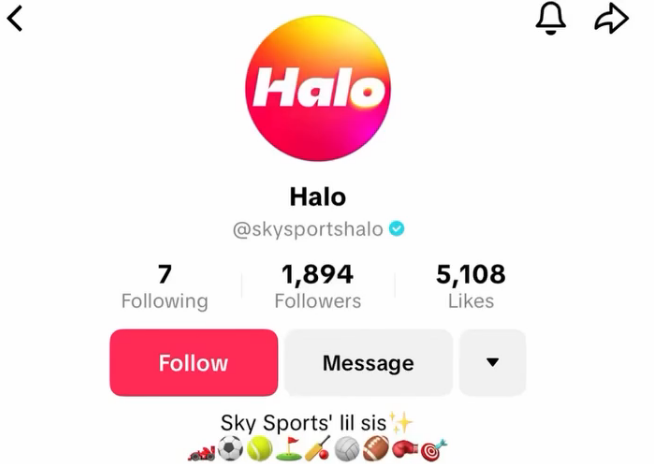
SkySports recently launched a new TikTok account, adding to its portfolio of five channels. Together they’ve accumulated more than 2 billion views and 167 million engagements on the platform.
At the time of writing, the SkySports Halo account has now deleted all but two of its posts with many lasting less than 48 hours. One post that remains introduces the channel as “Sky Sports’ lil sis”. The second post is an apology, explaining that all activity on the account is stopping.
Admittedly, SkySports Halo was never targeted at me. Nor do I work in social media marketing. But neither of those things need to be true for me to understand that SkySports Halo should never have happened. For those of us trying to engage with an audience on any platform, there are lessons (though many of them obvious) that can be taken from recent events.
Good intentions
The press release that announced the launch of the channel has since been removed from SkySports’ website. But such is the nature of the internet and the public relations industry, its shadow remains in the form of hundreds of syndications on websites that nobody outside of PR has ever visited before.
While undoubtedly executed in the wrong way, the press release is clear in communicating Halo’s good intentions. It states that Halo is targeted at female sports fans, calling it an “inclusive, dedicated platform for women to enjoy and explore content from all sports, while amplifying female voices and perspectives.”
And who can blame SkySports for riding the wave of another successful year in women’s sport. In 2025 alone we’ve seen a rugby world cup win on home soil, a second consecutive Euros win in football and reigning Olympic champion Keely Hodgkinson race to a World Championship medal. There is an endless list of sporting achievements by women to shout about and more happening every week, some of it even broadcast on SkySports. Had Halo considered highlighting any of this in its output then it might have met a different fate.
But the execution of Halo’s intentions is ultimately where it got lost and further down the press release things start to go awry. Halo claimed that it sought to build a community through “fun, trend-led, and relatable content,” which in practice translated to a clip of Erling Haaland scoring a goal for Manchester City with a caption about hot girl walks and matcha laid over the top. Because how else would a female audience understand sport.
In reality, SkySports Halo ended up not particularly speaking to anyone, but more so trying to encapsulate a vibe. One that screams: ‘I don’t really like sports at all but SkySports has a lovely grad scheme.’
Who is this for?
Halo’s biggest problem is that I don’t think it, or any of the taskforce behind it, even know what it is.
When one of its initial posts featured Formula One star Charles Leclerc and a caption about him being ‘a good man, Savannah’, a puzzled member of its alleged ‘target audience’ commented underneath asking whether SkySports Halo was a channel covering women’s sport or not.
The reply came in all lower-case letters, an idea you can imagine was perceived to be a touch of brilliance inside a meeting room somewhere. Capital letters are so un-chic and boring! Halo’s reply said: “we cover all sports”.
If not to cover women’s sport, then what was Halo really for? Clips from sporting events that happened weeks ago with irrelevant captions over the top in pink and orange fonts? Famously, the appeal of sport is not the impressive feats of athleticism, nor is it the sense of community that people often find in fan culture. It’s actually a clip of the newly elected mayor of New York with a caption about ‘rizzing us and Arsenal up’.
‘Okay, but can you name 5 of their players?’
The choices made around the language and branding of Halo seem to be an extension of the language that you can quite often see on TikTok. ‘Girl dinner’, ‘marketing girly’, ‘girl math’. Couple this language with the branding of the channel as a ‘lil sis’, and the whole thing is incredibly infantilising, not empowering.
This type of language is often polarising by itself even when it comes from female voices, let alone when it comes from a large news organisation with an already established tone of voice such as SkySports. Using it in this context feels incredibly misplaced. People don’t go to SkySports for memes, they go to it for sports.
It’s an odd and unnecessary move to create a new channel that says to female sports fans: ‘you probably didn’t like any of that stuff we’ve been putting out about sports, did you?’
In reality, women didn’t need sports dumbing down for them. There are enough men ready and waiting to patronise female fans and seeking to discredit their opinions. If Halo was truly meant to be a source of empowerment, framing it as a ‘lil sis’ and coating it in stereotypes is quite an interesting way to do it.
A good idea in the room
Many people took to LinkedIn to express their own opinions on where the whole concept went wrong. The majority asked how the idea ever got signed off, a question people often ask when they don’t like things but usually applied to the John Lewis ad or that new mince pie wrap from Sainsbury’s.
The reality is, that mince pie wrap is probably just trying to wind us all up. They’re just copying the strawberries and cream sandwich by M&S. Halo is trying to win someone over who doesn’t exist and winding everyone up in the process.
Now I can’t be sure who was in the room when this got signed off. A director at SkySports news responded to criticism on LinkedIn pleading that Halo was launched by a 100% female team.
Regardless, a good idea in the room might not always be a good one outside of it. The execution of Halo suggests that female sports fans weren’t consulted at all. There are thousands that could have said it was a bad idea.
It reaffirms the logic that you should not only know your audience and speak to them about what they want to see but seek feedback from a diverse range of people within that group too. Good ideas are great ideas in the room that have then been well-researched, evidenced and challenged by the real world.
Say Halo and wave goodbye
As it stands, the account remains and there is still a chance that SkySports Halo will post again, reconsidered and refreshed. But ultimately, I don’t know where SkySports go next with the idea.
The resounding response has been that fans don’t want a separate channel that has been apparently tailored to them. Unless Halo is going to be a place for more representation of women’s sport, it really isn’t needed at all.
It is so easy to criticise every aspect of Halo. As one commenter put it, Halo is “one of the most insanely patronising and misogynistic activations i’ve seen from a brand”. But in the interest of offering actionable advice on how better to launch similar content channels, there isn’t much to say that hasn’t already been said. Try not to patronise people and frame it as empowerment, just represent women more in your existing output.
Representation is seeing women occupy more of the spaces that we frequent day-to-day, not giving an infantilised voice to a corporation under a pink and orange hue. Rather than covering more of women’s successes in its existing output, Halo only serves to segregate female fans entirely and ensure they feel unwelcome.